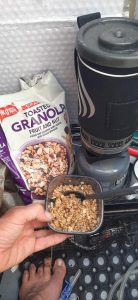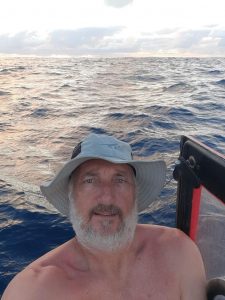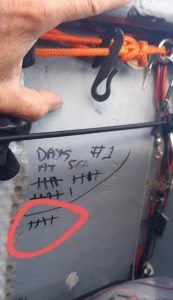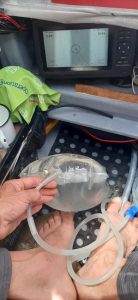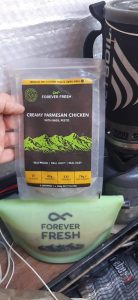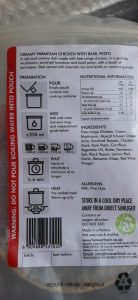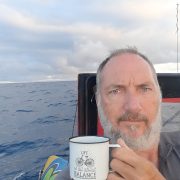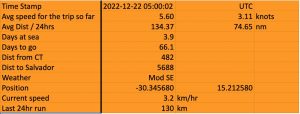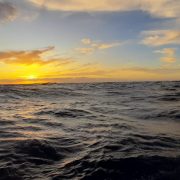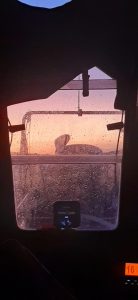
Day 6: What’s cooking?


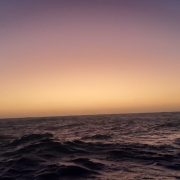
Red sky in the morning, paddlers warning

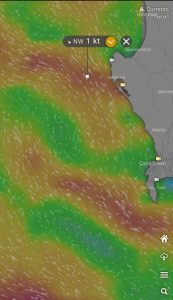
Strong NW current in my favour. Note: current name is give in the direction they are going unlike wind which is named for the direction it comes from
Deja vu. Take two.
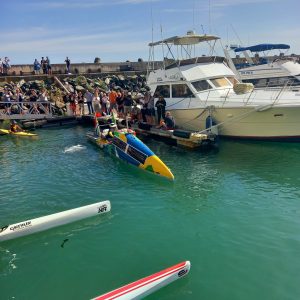
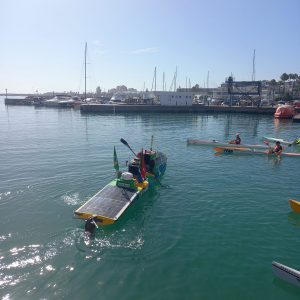
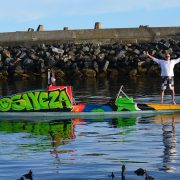
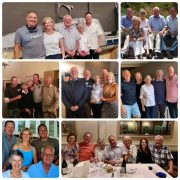
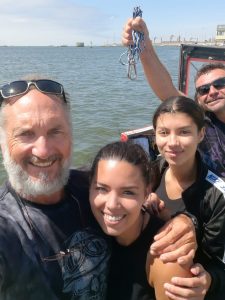
Too many to put down here but you get the idea. It was the start of my second attempt. Almost a carbon copy. If anything it is a great way to get all my family in one spot. Not to mention so many friends on and off the water. There were even a handful of school mates.
Thank you to everyone who came down to see me off and to the fleet of paddlers that escorted me for the first few miles. Priceless!

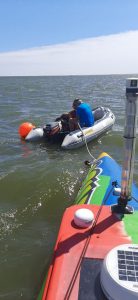
Eventually I was all alone paddling towards the horizon with Cape Town’s impressive Table Mountain slowly fading behind me. Slowly being the operative word. A head wind had started building. The forecast was for a Southerly wind to build. Not cool.
Eventually the forecast conditions started to build and I tried my best to put distance between Osiyeza and the shore. The swell was now getting a little out of my comfort zone. Crumbling peaks would wash over and flood the cockpit. I had to hold on to Osiyeza with one had and the other on the paddle.
Cold and very wet. Speeds improved but I suspect that was much to do with currents than my padding skills.
I popped down into the cabin to switch on the Satelite communication. I managed to down load my WhatsApp messages. By the time I had typed two messages and pushed sent a wave crashing came over me.
Not what you were thinking. A different wave. A dreadful wave.
It came from the pit of my stomach.
It was if a witch had cast a spell on me and turned me into a dog.
I flung open the hatch and stared barking like a dog. It probably sounded more like a dog in pain than a scary type of bark.🤮
After the dog spell was over I decided I would had to paddle through the night to stay out of the cabin and avoid any more spells.
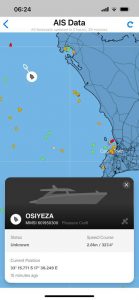
I managed to get to about midnight before I could do no more. I slipped into the cabin and just lay down and shut my eyes. Wet and cold I got a few half hours of rest. The other time was spent turning off the AIS alarm for ships around me.
Kind of feels just like day 1 last year.
Deja vu

Coordinates: -33.226900° 17.593400°
Amount raised for Operation Smile: R113,086
No of Smiles changed: 20
This is a story about endurance, courage against the odds, and the indomitability of the human spirit. It takes a man of unique vision to be the first person to paddle solo on a kayak unsupported for 7 000kms across the Southern Atlantic Ocean.
Richard first attempted the crossing in December 2021 but had to regrettably make a detour to Walvis Bay after being out at sea for more than two weeks. This was due to corrosion in his solar panel wiring and resulted in Richard not being able to charge all onboard batteries, which would seriously compromise his own safety. He is now ready to depart again this weekend on Saturday 17 December at 9am from the Radisson in Granger Bay.
After becoming the first and only person to paddle solo the entire circumference of the South African coastline in 2012, Richard Kohler has been training for Ocean X – his ultimate solo mission. After Covid delayed his departure in December 2020, and the corrosion of his solar panel wiring curtailed his first attempt, the 53-year-old Capetonian is raring to go solo on a kayak from Cape Town to Salvador in Brazil.
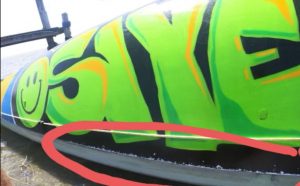
Richard is the first person to attempt to paddle a custom kayak across the Southern Atlantic, unsupported, and alone. He will be reunited with “Osiyeza” – his home for the next 60 to 80 days. The name deriving from SA music legend, Johnny Clegg’s 1993 song “The Crossing,” the literal meaning “we are coming”. The song is about a dream that’s within reach, the possibility to cross from darkness and suffering to prosperity and a reminder to Richard that his dream is within reach.
Richard intends surviving his “Crossing” and not just to acquire bragging rights for the latest outlandish watersports adventure. He is motivated by raising funds for charity, Operation Smile, which he has already raised over R112 000 for the charity. His aim is to raise enough money for 70 life changing cleft pallet operations, giving 70 kids new smiles.
To help Richard achieve his goal, please donate to his fundraiser here.
Follow Richards journey on www.richardkohler.co.za or @richardkohleradventures on social media.
Little did I know that the failure of Osiyeza’s solar panels would give me something special yet heart-breaking.
Little did I know that getting Osiyeza back home for repairs would give me a wonderful opportunity in such a dark time.
The universe works in mysterious ways. I could have been in the middle of the Atlantic Ocean. Without family or friends. All alone.
I do not know how I would have coped.
It was the day, more than a week ago when I put Osiyeza onto the trailer in Walvis Bay that my father was rushed to hospital.
The silver lining is, I got to sit by his side to talk with him.
To tell him I was OK.
To tell him he was going to be OK.
To tell him how much I love him.
My time and focus is with my family as we walk together along a path of uncertainty.
Osiyeza is safely tucked up on her trailer and will patiently wait until I can give her my full attention again.
Thank you for your incredible support thus far.
Pause, reset.
“NEVER GIVE UP”
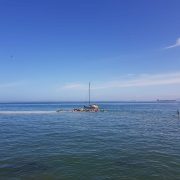
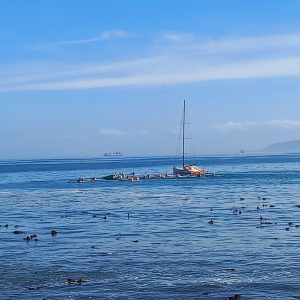
⚓ Oziyesa on the rocks ⚓
It’s a message you never want to get.😱
Plan “C”!
Unfortunately, the truck ride for Osiyeza to Cape Town fails to take shape as hoped. The backup Plan “D” is initiated on Wednesday. My brother-in-law, Kevin, and mate Ralph are going to drive up to Walvis Bay with a trailer and so we will tow Oziyesa home.
Sounds simple enough!
Get an affidavit from the owner to take the trailer across the border. Get the new license disk printed from the traffic department. Have your nostrils scraped for the PCR test at least 72 hours before crossing into Namibia and quickly check and grease the wheel bearings.
All items get sorted with great effort except the traffic department. They are offline!
For two full days nothing can happen.
The 72 hours’ time limit is starting to run out. Final option is to get the disk on Saturday morning on the third day and rush up to the border with a few hours to spare.
Stellenbosch traffic department, who apparently are the only department that can issue the license, decide not to open. No reason given. They must have decided that if they were offline on Friday why open on Saturday?
Plan “D” is still in the making.
Kevin and Ralph have gone for another nasal probe and are waiting for the results. Monday morning, fingers crossed, they can get the license disk and start the two-day trek to Walvis Bay.
In the meantime, I have been getting prepared on this end for their arrival. With the help of John Woolf, a local surfski paddler from Swakopmund, and Michael, a local yachtsman we moved Osiyeza under one of the jetties. We do this so I can suspend the keel using the jetty. Once lifted a few inches I can remove the bolts and drop the keel out through the bottom of the keel box. It was a smooth operation and with the help of a small chain block we retrieved the keel from the seabed and hauled it ashore.
With the keel removed Osiyeza can lie flat on the trailer. We also managed to collect ten old car tyres from a local fitment centre on which Osiyeza will rest before being strapped tightly down onto the trailer. We then moved Osiyeza back to her mooring buoy.
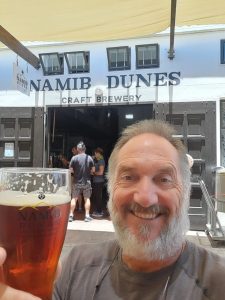
I spent the weekend with John and took in the sights of Swakopmund. I had a grand old time. Meeting so many wonderful people. A chance stop at the Namib Dunes Craft Brewery that filled most of Saturday afternoon if you know what I mean. 🍻

We did the local coffee houses, Slow Town and Two Beards. Both excellent.
In the evening it’s a family affair at the Woolf’s to play cards. I have not played a card game in more than a decade, but you can’t not join in. It must have been beginners’ luck as I ended up coming out tops. The reward was a Sunday treat to Ice & Spice, the local ice cream parlour.
It was on the way here that I received the message.
“Urgently get hold of the Yacht Club. You kayak has come off its mooring”
Oh crap!
How?
Faaak!
John and I rush off to Walvis Bay and to the yacht club. We manage to get hold of the Commodore, Theo, and he says Osiyeza has been towed to the club jetty. You can imagine what thoughts were racing through my mind.
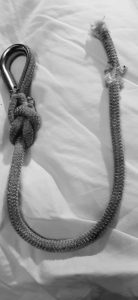
When we got to the club, I found Osiyeza almost high and dry on the beach in front of the clubhouse. The line that was tied to the buoy had chaffed through.

The kind people who rescued Osiyeza explained that they saw her drifting from the mooring and then onto the rocks. They went with their boat to see what they could do. The one lady said she jumped in the water and swam between Osiyeza and the rocks to push her off. She successfully managed to do this but got quite a bruising for her efforts.


Inspecting Osiyeza I could not see any structural damage, so we eventually pushed Osiyeza off the beach and towed her to another mooring. This time I tied her up with much thicker lines courtesy of Michael’s yacht.
I shudder when I think what would have happened if she broke loose during the night when there was no one there to see or rescue her!
A close call but “all well that ends well.”
I have been here for seven days and am no closer to solving the issues with Osiyeza.
Feeling so frustrated but give thanks to the amazing folk looking after me which makes it all a little more tolerable.

So, what now?
Yes, a very good question! Let me try to answer it.
Warning: This may be a little technical and boring.
Let’s call this PLAN C.
1) By now you know the reason for the hard right hand turn to get to Walvis Bay was triggered by the failure of the main solar panels, on the aft deck, to charge the batteries.
When I was doing my research on what was the most common issues on ocean rowing boats (very few kayaks that have crossed an ocean) a thread that repeated itself was the lack of power from the batteries for a variety of reasons.
The power issues are almost always a knock-on effect of too little charge from the PV panel from a fault or corrosion, like I have, or too little sun light or just not enough solar panels for the boats power consumption.
We had to redesign the back deck of Osiyeza to take the massive panels. I did not want to be in a situation as described above. I have 470Watts of PV Panels which is a LOT. I also chose the best flexible marine panels in the market and imported them from Italy. The Super Rugged Solbian panels are completely waterproof and tough enough to walk on. They are glued to the back deck with pre attached 3M peel and stick.
The wiring runs inside a watertight buoyancy box. Basically, the top half of the back deck, so “should” have no contact with sea water. The wire connectors are also waterproof so if water does get in then it should still not be a problem.
For them to fail means that both defences have been breached.
We know water got into the sealed buoyancy box. The second defence breach I am yet to identify. Is it the connectors or the panel junction box?
To access the wires an inspection hole will need to be cut into the side of Osiyeza that is big enough to get hands and equipment inside. Then it’s to identify where the leak is and seal it. Once that’s completed the inspection hole that was cut out needs to be bonded back in place making sure that the hull is still structured sound.
And that’s if it’s not a problem with a panel. In that case I would have to remove the faulty panel and find a replacement. Not a small job and let’s not forget Osiyeza is constructed out of carbon fibre so a little more skill and material is required.
2) From discussions over the past two days with several experts it seems the autopilot system will need to be redesigned, manufactured, installed, and tested. Not a small project.
The autopilot cable inside Osiyeza.
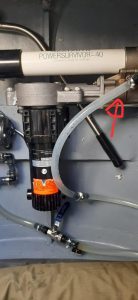
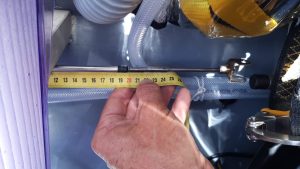
3) A solution to stopping the air that is being sucked in through the water maker intake needs to be found. With Osiyeza being so light the water intake is only 200mm below the waterline and with all the rocking and rolling air bubbles get sucked in along with the water. I did install a small sea chest to remove the air bubbles but 200mm is just not enough height for it to work in anything other than flat water.
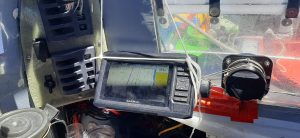
4) The solution to the chart plotter GPS signal is to find and install an external antenna.
Chartplotter hanging by strings to get better GPS signal.
5) The rudder had a loud knocking noise which I think is the movement between the pin and bush. How serious an issue this is I don’t know but it needs to be looked at.
6) My floating bridle is cunning design but a practical failure. It needs to be redesigned.
7) The seat is super comfy, but it’s not made to be used 24/7. I need to find someone who can make up a new cover.
8) The canard cover was ripped off while on sea anchor. This needs to be replaced and hopefully the modified bridle system will avoid a repeat.
With all these items to attend to we have made the call to get Osiyeza back to Cape Town where the marine industry is best equipped to assist. We hope to have her on a truck and in Cape Town this weekend. I plan to fly back on Friday after loading Osiyeza onto the truck.
Hopefully it’s a quick turn around with no major hiccups.
Plan D
Right now, is to get Osiyeza back to Walvis Bay ASAP to continue the crossing to Salvador.
Fingers crossed 🤞🤞🤞🤞🤞🤞🤞
No of smiles changed: 20. Thank you to everyone who has donated.